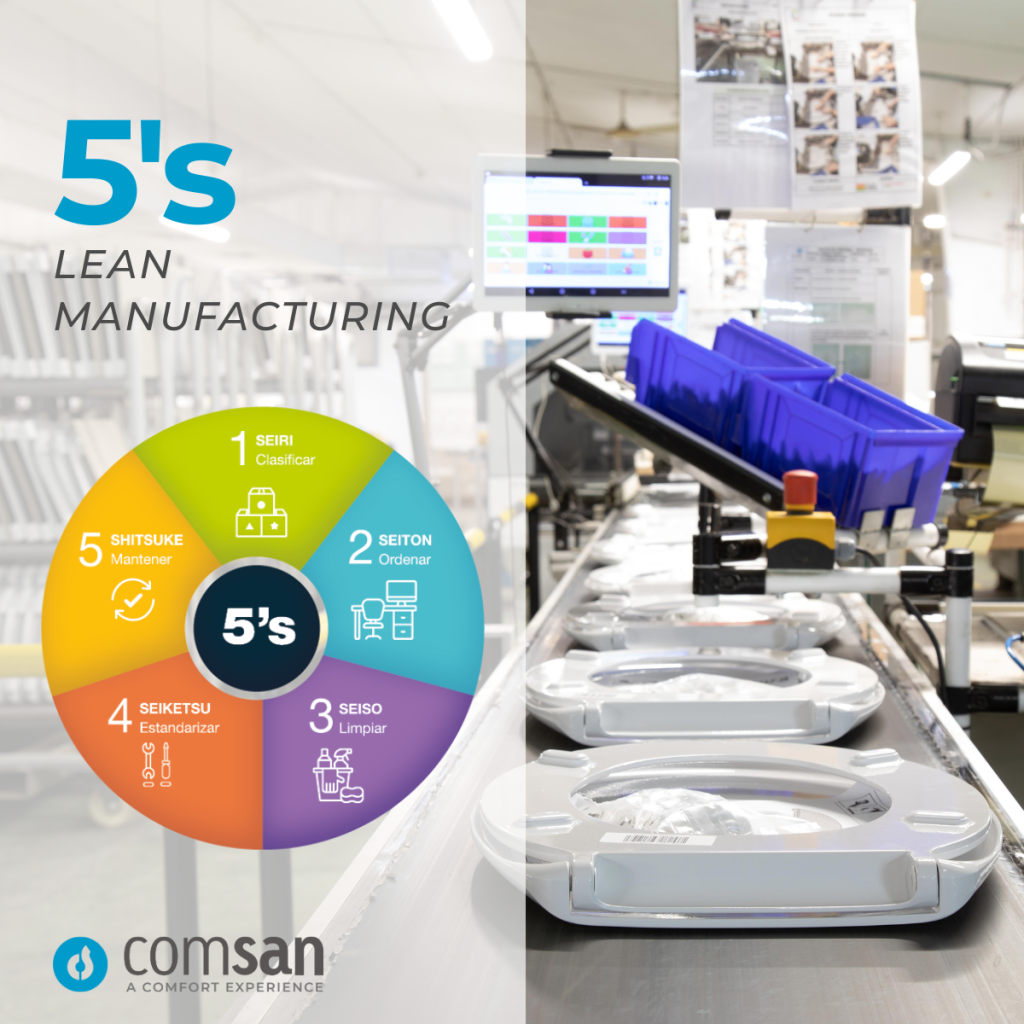
Since 2020, COMSAN has implemented the Lean Manufacturing methodology in our toilet seat manufacturing plant and developed our own management system called CBS, Comsan Business System. Since then, among many other improvements, we follow the 5S principles and focus on identifying the 8 types of waste, with the goal of eliminating any element that does not add value for the customer and that increases costs or delays the manufacturing process.
The 8 wastes concept is a key tool for improving our production processes. It helps us distinguish between activities that are necessary and those that are not. One of its advantages is that it does not require any prior knowledge and the concept itself is very straightforward—they are simply “wastes.”
According to the Lean methodology, waste (known as muda in Japanese) refers to any activity or element within the production chain that consumes resources but does not add value to the final product for the customer.
The term muda was introduced by Taiichi Ohno, an industrial engineer at Toyota, during his efforts to optimize manufacturing processes in post-war Japan.
“The first step toward improvement is seeing the waste. Until you see it, you cannot eliminate it.”— Taiichi Ohno, creator of the Toyota Production System.

Example: Excessive arm movements or long reaches to pick up tools or materials.
Impact: Slower production flow and potential ergonomic risks that may lead to accidents.
Solution: Reorganizing the workspace or plant layout to eliminate unnecessary movements.

Moving materials is a type of waste that does not add value. It consumes time and energy, disrupts production flow, and creates disconnection between workstations. This can lead to intermediate inventories or idle equipment and personnel. When electric forklifts are used, they also require energy to recharge their batteries.
Example: An operator walking long distances from their workstation to retrieve tools or materials.
Impact: No value is added to the process and production flow is disrupted.
Solution: Optimize processes to eliminate non-value-adding activities.

Overproduction occurs when more products are made than required or when production does not match customer demand. Companies often do this to avoid potential stock shortages, but it is a poor practice because it uses resources, personnel, and time unnecessarily, resources that could be dedicated to higher-priority tasks. It also ties up capital in stored goods, increasing costs due to storage and inventory management.
Example: Producing work orders simply to keep machines and personnel busy.
Impact: Excess production consumes energy, labor capacity, natural resources, and storage space.
Solution: Conduct demand analysis or request customer sales forecasts at the start of a project to better plan production.

Finished goods, work-in-progress products, and raw materials purchased before the customer needs them require energy and resources for handling and storage, directly impacting the company’s profitability.
Example: Storing obsolete products that cannot be recycled or repaired.
Impact: Unnecessary costs while waiting for the return on investment in labor, raw materials, and processing. Storage also requires space, lighting, and conditioning. Materials may deteriorate or become obsolete over time.
Solution: Carry out regular annual inventory reviews to remove items that no longer add value and better align with demand.

This waste occurs when people or equipment remain idle, often due to delays in the previous process, interruptions in the next stage, or shortages of raw materials.
Example: Downtime caused by interruptions in production flow.
Impact: Production flow is disrupted, productive staff remain idle, and customer orders may not be delivered on time. Energy-intensive activities may continue running and consuming resources unnecessarily.
Solution: Implement continuous improvement processes to identify the root causes of these production stoppages.

This occurs when processes, machines, tools, or methods are used that do not match the actual needs of the product being manufactured. It can happen when the wrong tool is selected, when equipment is worn out, or when it does not function properly.
Example: Using an incorrect tool or improvising a tool.
Impact: Unreliable tools can cause damage, increase resource consumption, or lead to equipment failures. Execution time and quality may fall below required standards, potentially leading to rejected products.
Solution: Analyze the process to determine the most appropriate tools and machinery for each activity.

Producing defective products generates waste because these parts cannot be sold. They must either be discarded or reprocessed since they are not suitable for the next production stage. Defective production should be eliminated rather than accepted as a normal part of the process.
Example: Manufacturing products that do not meet the factory’s quality standards and therefore cannot be sold to customers.
Impact: Direct costs due to lost parts, wasted materials, and additional time and energy required for reprocessing.
Solution: Establish quality control checks within the production process to detect defects as early as possible.

Failing to make use of employees’ skills, ideas, and creativity to improve processes and products is also a form of waste. People drive a company forward, and ignoring their insights is one of the greatest missed opportunities.
Example: Not listening to improvement suggestions from workers who perform the daily tasks.
Impact: Slower company progress and reduced employee motivation.
Solution: At COMSAN, we organize Kaizen sessions, where employees from different departments contribute ideas and solutions to challenges in production processes. This allows us to gain different perspectives and enrich our collective experience.